

Traffic Arbitrage: The Hidden Online Business Most Beginners Ignore
Traffic Arbitrage is one of those online business models that sounds almost too simple when you first hear how it works.
You buy traffic at one price, send those visitors somewhere they can generate revenue, and try to keep the difference.
No physical inventory. No shipping. No warehouse. And unlike traditional blogging, you don’t necessarily have to wait months for organic traffic to arrive.
Some marketers have built businesses around buying visitors at one cost and monetizing that traffic at a higher value. Yet compared with affiliate marketing, freelancing, dropshipping, or YouTube, Traffic Arbitrage gets surprisingly little attention from beginners.
So how does it actually work, and why do some campaigns make money while others burn through the budget?
Let’s break it down.
What Is Traffic Arbitrage?
Imagine buying a product for $1 in one market and selling it for $5 somewhere else.
You didn’t manufacture the product. You simply found a difference between the buying price and the selling price.
That’s arbitrage.
With Traffic Arbitrage, you’re buying visitors instead of physical products. You then send those visitors to monetized content and try to generate more revenue than you paid to acquire them.
The basic model is:
Buy Traffic → Monetize Traffic → Measure the Difference
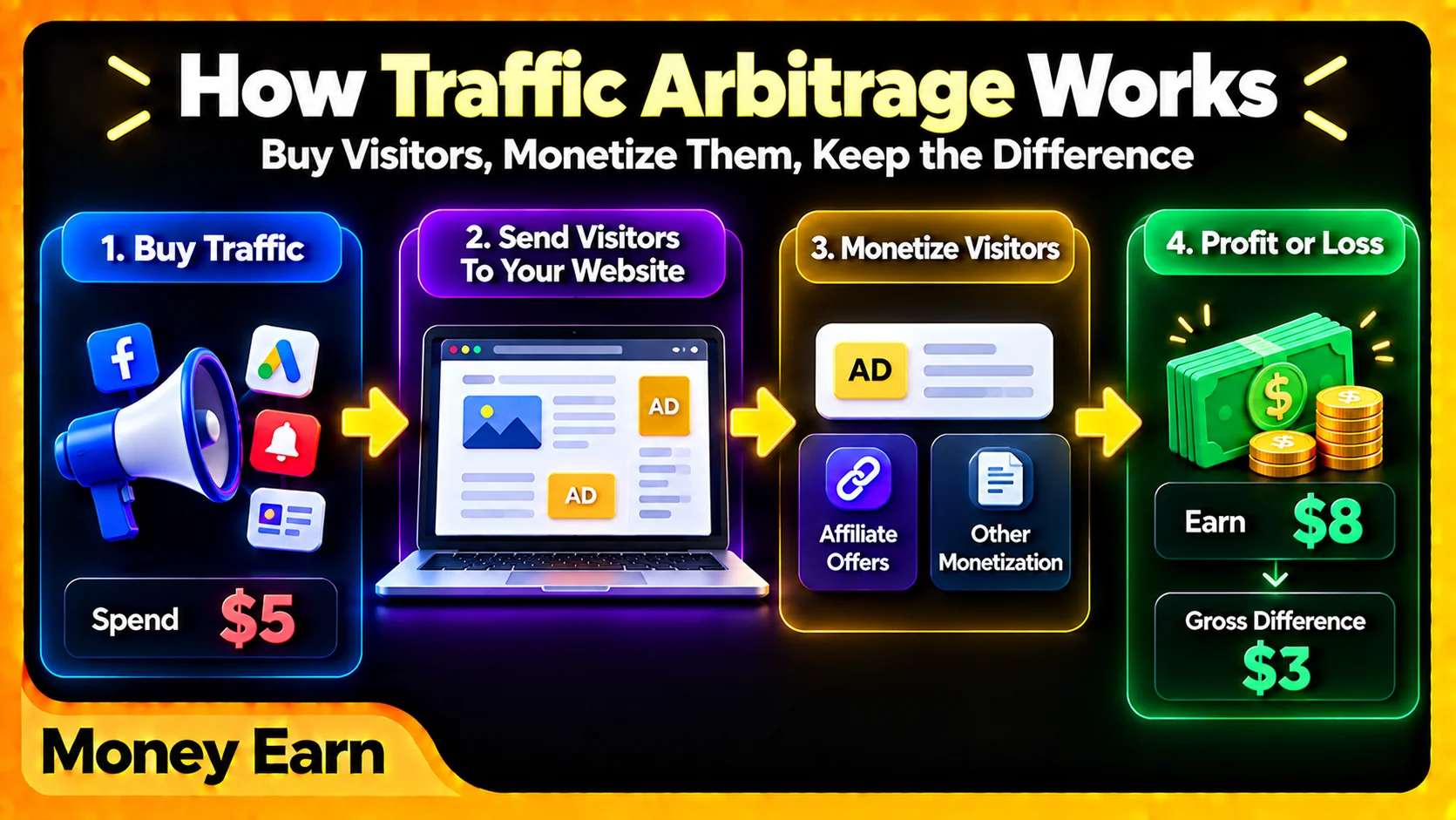
For example, imagine spending $5 on a campaign that sends visitors to your website.
If those visitors generate $8 in revenue, the simplified gross difference is $3 before considering other costs.
If they generate only $2, you’ve lost money.
That’s why Traffic Arbitrage isn’t a magic money machine. The entire business revolves around finding combinations where revenue exceeds acquisition costs.
Why Traffic Arbitrage Is Different
Traditional website owners often focus almost entirely on free traffic.
They publish SEO content, create Pinterest Pins, post TikTok videos, grow social accounts, and wait for visitors.
Those strategies can work extremely well, but Traffic Arbitrage asks a different question:
What if you simply buy the traffic?
Instead of waiting months to collect data, paid traffic can let you begin testing much sooner.
You launch a campaign, measure the results, stop losing combinations, optimize promising ones, and test again.
That’s the attraction of the model.
It’s less about waiting and more about numbers.
Step 1: Build a Useful Website or Landing Page
You need somewhere to send your visitors.
A simple website can cover topics such as technology, apps, games, AI tools, useful resources, entertainment, or tutorials.
Blogger can be one starting option because it doesn’t require traditional paid hosting. You can also use another platform that fits your project.
But don’t misunderstand the strategy.
The objective isn’t to create an empty page covered with advertisements.
Your page still needs a reason to exist.
Visitors should find useful content, information, resources, or another experience worth staying for. If people immediately leave because the page offers nothing useful, cheap traffic alone won’t save the campaign.
Step 2: Monetize the Traffic
Once visitors reach the website, you need an appropriate way to generate revenue.
Advertising is one possibility. Publisher networks can offer different advertising formats depending on their current requirements, policies, and available programs.
If you want to test this model yourself, you can create a free Monetag account and explore the available monetization options for your traffic.
One monetization method you can explore is Direct Link monetization, which I explain step by step in my complete Monetag Direct Link guide.
Some publishers may also test multiple monetization methods when their respective terms allow it.
But more advertising doesn’t automatically mean more profit.
Overloading a website with ads can destroy the user experience, reduce engagement, and potentially hurt the economics of the campaign.
The goal isn’t:
Maximum Ads
It’s:
Maximum Sustainable Revenue Per Visitor
That distinction matters.
Step 3: Buy Traffic
Now we reach the core of Traffic Arbitrage.
Paid traffic can come through formats such as push, native, display, pop, and other advertising methods.
Prices can vary dramatically based on country, device, operating system, competition, traffic source, targeting, audience, and ad format.
This creates the potential arbitrage opportunity.
But don’t search blindly for the cheapest visitors available.
You’re looking for traffic that costs less than its monetization potential.
A visitor costing $0.01 isn’t cheap if that visitor generates almost nothing. A more expensive visitor could potentially be better if the revenue generated is significantly higher.
Cost and value have to be analyzed together.
Start With a Small Traffic Arbitrage Test
One of the easiest ways to lose money is starting too big.
You see somebody showing impressive campaign results and think:
“If $10 works, I’ll start with $500.”
That’s a dangerous assumption.
Start with a small test budget that you’re prepared to lose.
For example, you might run a $5 test and measure how many visitors arrive, how they behave, which locations and devices perform, and how much revenue the campaign generates.
If $5 generates $3, you’re losing.
If $5 generates around $5, you’re near break-even before other costs.
If $5 generates $8, the campaign becomes more interesting.
The simplified calculation is:
Revenue − Traffic Cost = Gross Campaign Difference
Real campaign analysis can involve additional costs and metrics, but this gives you the basic idea.
Cheap Traffic Can Be a Trap
Beginners often find an incredibly cheap traffic source and immediately think they’ve discovered the secret.
Not necessarily.
Low-cost traffic is useless if visitors don’t engage or generate enough revenue.
Traffic quality can vary between sources, placements, countries, devices, and campaigns. Performance can also change over time.
That’s why the objective isn’t simply:
Buy Cheap Traffic
It’s:
Buy Traffic at a Cost That Makes the Campaign Economics Work
Never assume a traffic provider will work simply because somebody recommended it in a tutorial.
Test the traffic you’re actually receiving.
Your data matters more than somebody else’s screenshot.
Targeting and Filtering Matter
Imagine buying 10,000 visitors.
That number sounds impressive, but it tells you very little by itself.
Where did they come from? Which devices did they use? What did each visitor cost? How much revenue did different segments generate?
You might discover that:
Country A + Android + Placement X
performs significantly better than:
Country B + Desktop + Placement Y
If one segment generates most of the useful revenue while another burns your budget, you can adjust the campaign where your advertising platform allows it.
This is the hidden side of Traffic Arbitrage.
The strategy isn’t:
Buy Visitors → Become Rich
It’s:
Buy → Measure → Filter → Optimize → Test Again
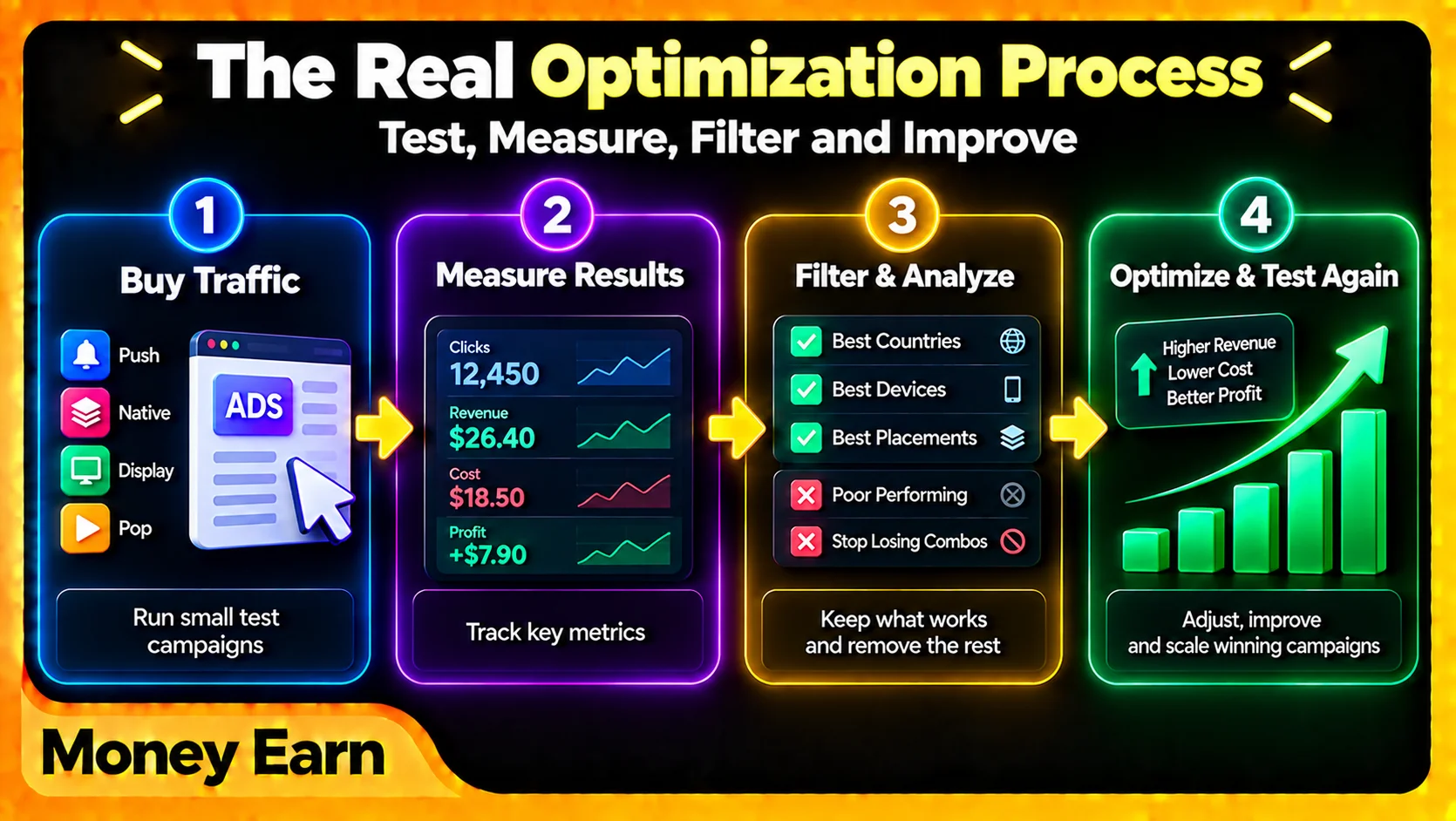
That’s the real process.
Improve the Landing Page Too
Traffic is only half of the equation.
The destination matters.
If you’re buying inexpensive visitors but nearly everyone immediately leaves the website, you may not need cheaper traffic.
You may need a better page.
Look at loading speed, mobile usability, headlines, content quality, navigation, advertising placement, calls to action, and the overall user experience.
Even a relatively small improvement in revenue per visitor can affect the economics of a campaign.
This gives you two major areas to optimize: reduce acquisition costs and increase the value generated by each visitor.
Ideally, you work on both.
How to Scale a Winning Campaign
Suppose your $5 test performs well.
Don’t immediately increase the campaign to $500 and assume you’ll get identical results.
Increasing volume can change traffic quality, placements, costs, competition, and monetization performance.
Instead, scale gradually while continuing to monitor the numbers.
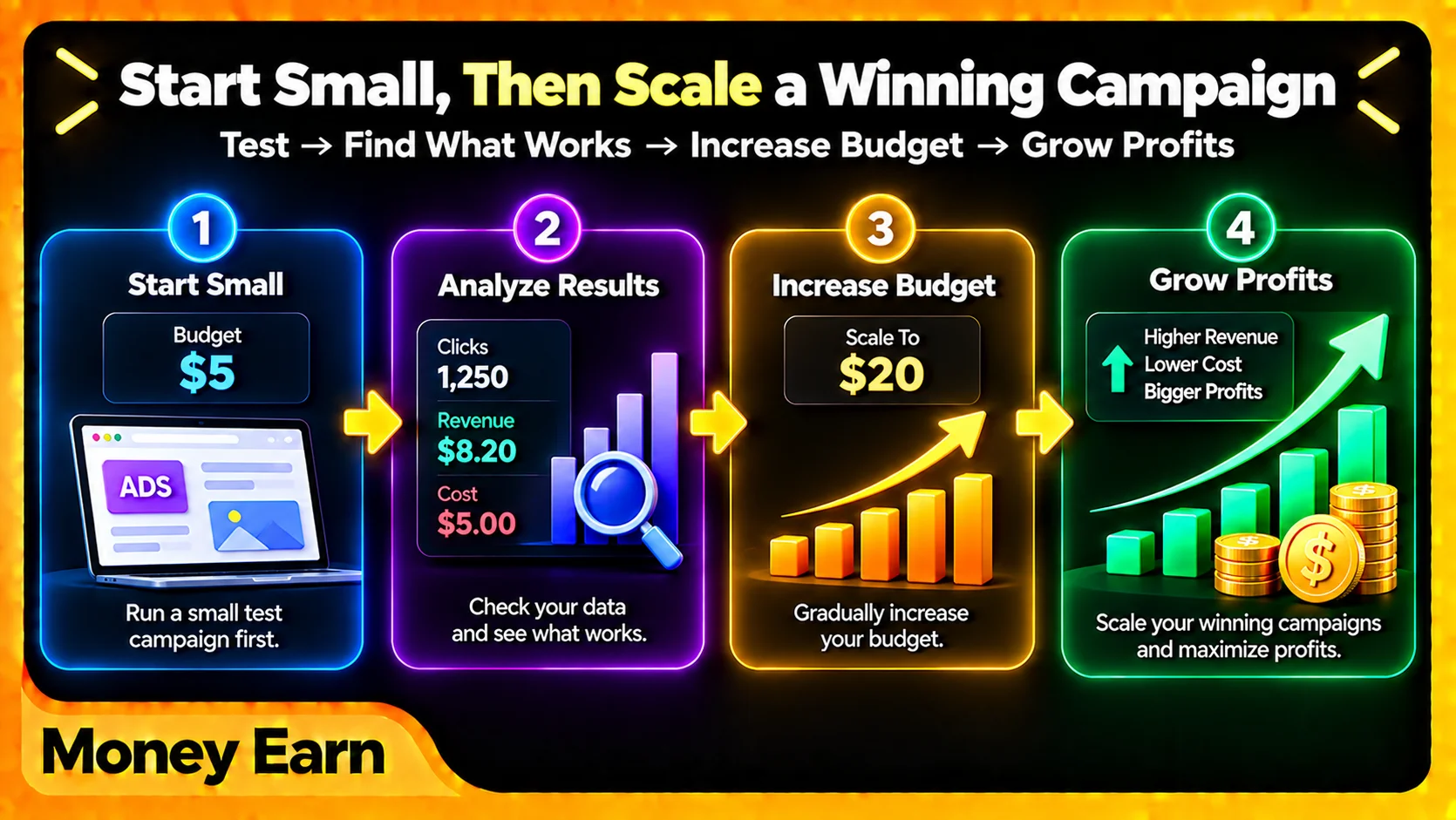
For example:
$5 → $10 → $20 → $40
If performance remains healthy, you have more evidence supporting further testing.
If performance deteriorates, investigate before adding more money.
Scale with data, not excitement.
The Real Traffic Arbitrage Formula
At its core, the business model is simple:
Buy Traffic for Less Than the Revenue It Generates
Everything else is optimization.
You can try to reduce acquisition costs through better targeting, stronger traffic sources, placement filtering, or testing different countries and devices.
You can also work on increasing revenue per visitor through better landing pages, stronger engagement, faster loading, appropriate monetization formats, and improved content.
The gap between acquisition cost and revenue is where the potential margin exists.
Common Traffic Arbitrage Mistakes
Several mistakes can quickly destroy a campaign.
Starting with a large budget before proving anything is one of them. Another is buying the cheapest possible traffic without considering quality.
You also need to track where your results come from. If you don’t know which placements, countries, devices, or campaigns are generating revenue and which are losing money, you’re essentially guessing.
Scaling too quickly creates another risk. A profitable $5 test doesn’t guarantee identical performance at $500.
And don’t destroy the website with excessive advertising. More ads don’t automatically produce more overall profit.
Finally, understand the rules of both your traffic provider and monetization partners. A campaign isn’t useful if the traffic method or implementation violates the services you’re depending on.
Can Beginners Make Money With Traffic Arbitrage?
Beginners can learn Traffic Arbitrage because the basic concept is easy to understand.
But simple doesn’t mean guaranteed.
The difference between randomly buying traffic and operating a real campaign is measurement.
You need to know what you spent, what came back, where visitors came from, which traffic performed, which segments lost money, and what you can change.
Think like an experimenter rather than a gambler.
Your first campaign doesn’t need to make you rich.
Its first job is to give you useful data.
A Simple Traffic Arbitrage Plan for Beginners
Start with one legitimate content angle and build a simple, fast website or landing page around it.
Choose a monetization method that permits the traffic you intend to use, then select one paid traffic source and begin with a small test budget.
Track your spending, traffic, revenue, geography, devices, and available placement data. Identify poor-performing segments and look for promising ones.
Then improve your targeting or landing page and run another controlled test.
Only start increasing the budget when the numbers give you a reason to do so.
You don’t need a complicated operation at the beginning.
Prove the basic economics first.
Final Thoughts: Traffic Arbitrage Is a Numbers Game
At its core, Traffic Arbitrage is simple.
Buy traffic, monetize it, and aim to generate more revenue than the relevant costs.
But between buying traffic and making a profit, there’s targeting, testing, analytics, landing-page optimization, traffic quality, devices, countries, placements, and monetization.
That’s where the actual skill lives.
Two people can appear to run the same strategy while getting completely different results because their traffic quality, targeting, pages, and optimization are different.
So don’t approach your first campaign asking:
“How can I turn $5 into $20 every time?”
Ask:
“How can I spend a small amount to discover a combination worth testing further?”
That’s a much smarter way to approach Traffic Arbitrage.
Find a combination where the numbers make sense, optimize it carefully, and only then consider scaling.
Frequently Asked Questions
What Is Traffic Arbitrage?
Traffic Arbitrage is a strategy where you purchase online traffic and attempt to monetize those visitors for more than the relevant cost of acquiring them.
Can You Make Money With Traffic Arbitrage?
A campaign can generate a positive margin when its revenue exceeds its relevant costs. Other campaigns can lose money, which is why testing and optimization are essential.
How Much Money Do I Need to Start Traffic Arbitrage?
You don’t necessarily need a large initial budget. A small test can help you collect data before deciding whether a campaign deserves additional spending.
Can I Use Blogger for Traffic Arbitrage?
Blogger can host web content without traditional paid hosting. Whether a particular traffic or monetization setup is permitted depends on the policies of the services involved.
Is Cheap Traffic Always Better?
No. Traffic Arbitrage depends on the relationship between acquisition cost and the revenue that traffic generates. Extremely cheap traffic can still be unprofitable if its quality or monetization performance is poor.