

Internet Archive: 5 Powerful Ways to Turn Free Traffic Into Online Income
What if there were a massive website receiving well over 100 million visits a month, with millions of pages appearing in search results and people actively looking for books, software, documents, audio, videos, historical material, and downloadable resources?
Most online marketers barely think about it as a traffic source.
That website is Internet Archive.
Internet Archive is a nonprofit digital library containing an enormous collection of digital material. The interesting opportunity isn’t simply its size; it’s that useful resources published there can potentially be discovered through both the platform itself and search engines, creating another distribution channel for content you’ve already created. Pasted markdown
Internet Archive itself isn’t the business, though. The opportunity is using useful resources to attract attention and connect that attention to a legitimate monetization model.
In this guide, we’ll explore 5 powerful Internet Archive strategies for turning useful files into traffic assets that can support the rest of your online business.
What Is Internet Archive?
Internet Archive is much bigger than the Wayback Machine most people know it for. The platform preserves and provides access to huge collections of books, websites, audio, video, software, images, documents, and other digital material.
For marketers and content creators, the important question isn’t, “How many random files can I upload?”
It’s:
“What useful resource can I publish that people are already searching for?”
That’s a much stronger starting point because Internet Archive isn’t the product you’re selling.
It’s the distribution channel.
The platform itself doesn’t simply pay you whenever somebody downloads your PDF. Instead, your resource can introduce people to another part of your business.
The basic model is:
Useful Resource → Discovery → Traffic → Monetization
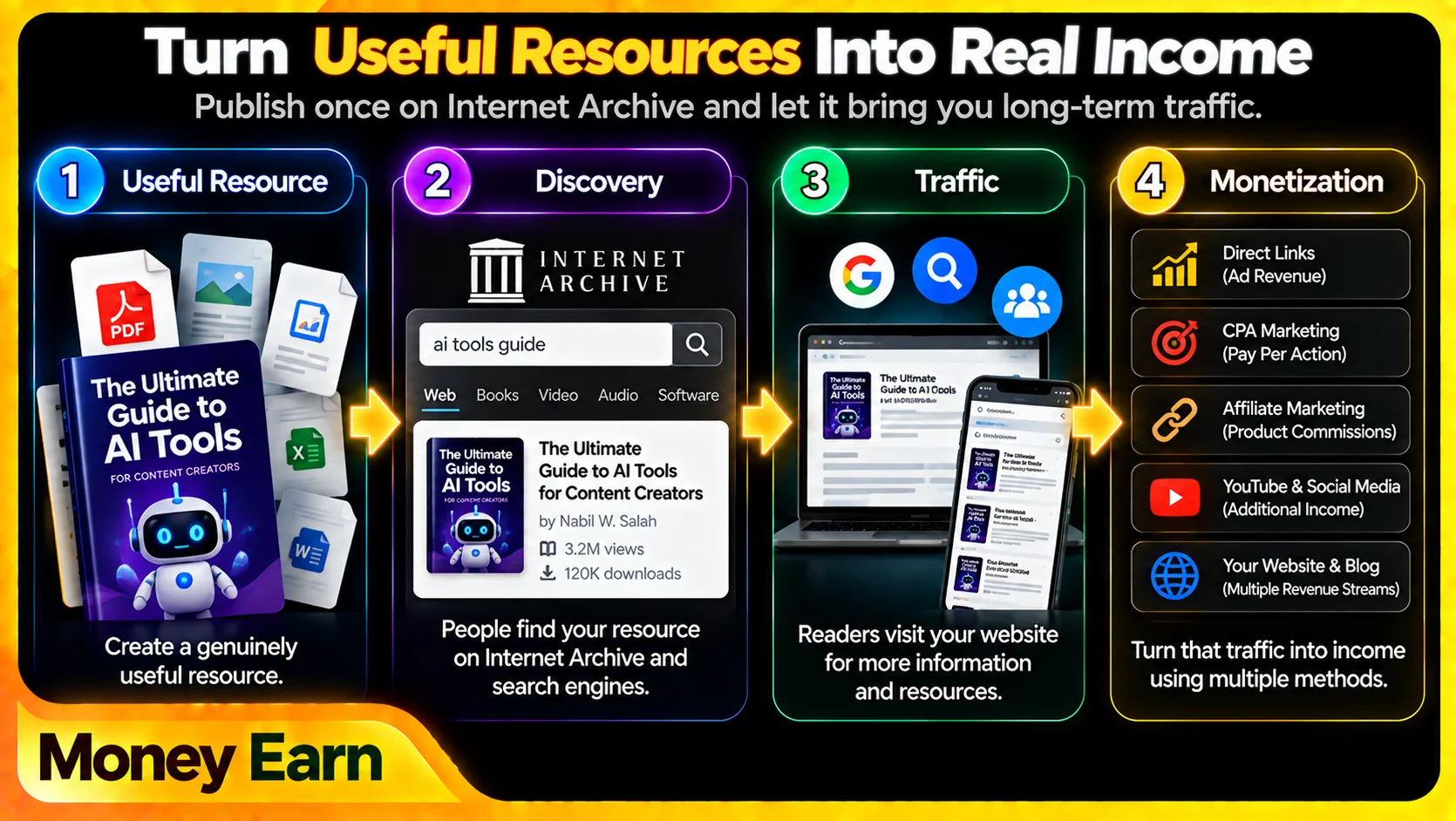
Once you understand that, several interesting strategies become possible.
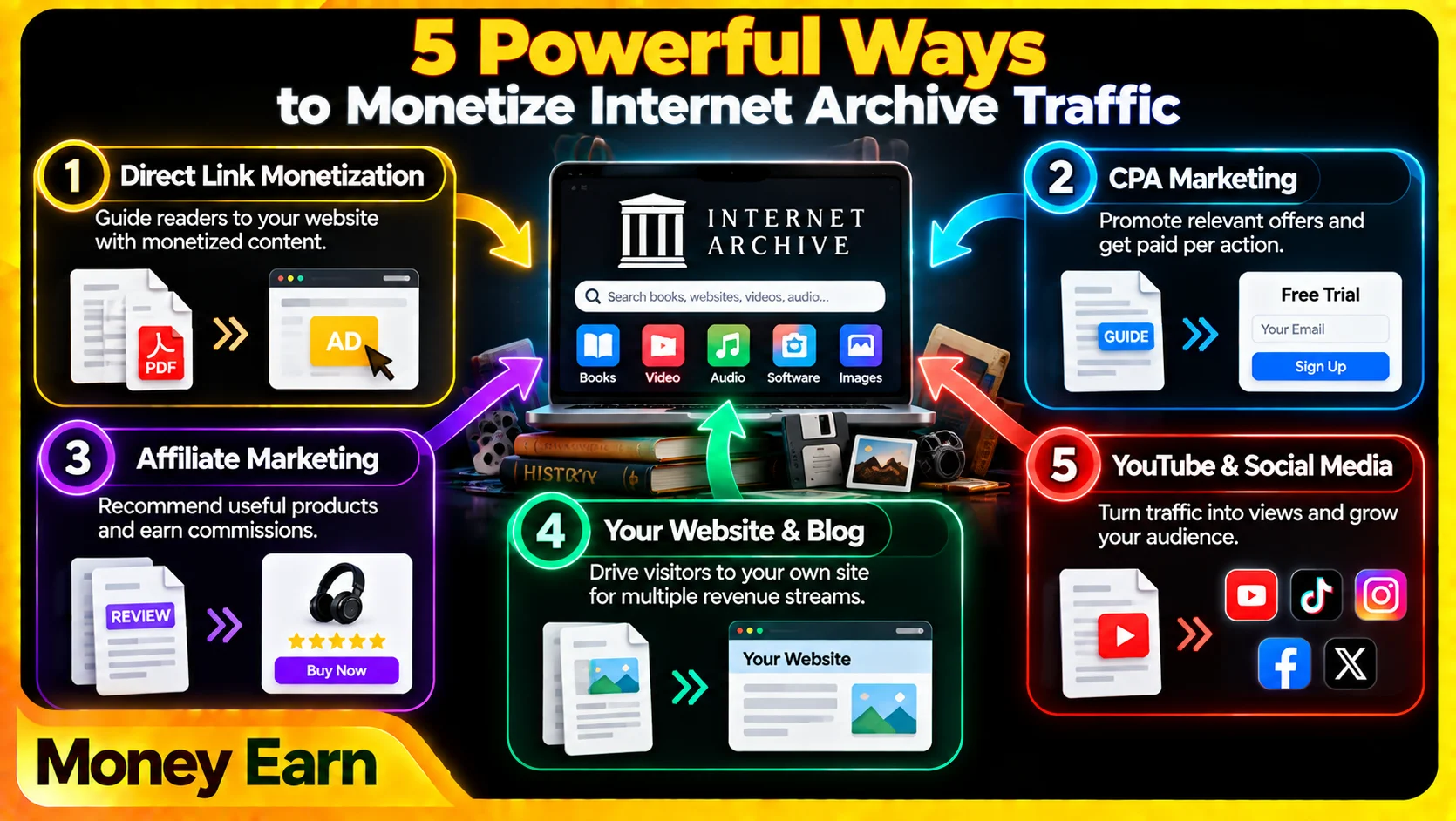
1. Internet Archive + Direct Link Monetization
The first strategy combines Internet Archive with Direct Link Monetization.
If you’re new to this model, read my complete guide to Direct Link Monetization to understand how the strategy works before using Internet Archive as a traffic source.
If you’re already working with an advertising network such as Monetag, you might be tempted to create files simply to push people toward monetized links. That’s the wrong approach.
Start with genuine demand.
Maybe you’ve created an original study guide, useful checklist, free template, open-source resource, detailed tutorial, or reference document. The resource itself should be worth finding even before monetization enters the picture.
Where the applicable platform and advertising-network rules permit it, that resource can direct interested readers toward a relevant page on your own website containing additional information, related resources, tools, downloads, or monetized content.
The funnel becomes:
Internet Archive → Useful Resource → Your Website → Monetization
The difference is that the visitor now has a legitimate reason to continue.
Think Traffic Funnel, Not Monetized Link
Beginners often obsess over where they can place a Direct Link. A much more useful question is why somebody would want to click in the first place.
Imagine publishing an original guide called “100 Free AI Tools for Content Creators.” The guide itself provides useful information, but you also maintain a companion page containing updated resources, demonstrations, or additional tools.
Someone reading the guide now has a logical reason to visit your website.
That’s how Internet Archive can become part of a traffic funnel rather than another place to dump links.
2. Internet Archive + CPA Marketing
The second strategy combines Internet Archive with CPA Marketing.
CPA stands for Cost Per Action. Depending on the campaign, advertisers may pay when an eligible user completes a defined action such as installing an app, registering for a service, requesting information, or starting a trial.
The offer still needs to make sense in context.
Don’t disguise an advertisement as something else or trick readers into completing actions. Instead, create useful content around a genuine audience need and introduce a relevant CPA offer transparently where appropriate.
For example, an original resource about productivity software could naturally discuss a relevant software offer if that offer genuinely fits the content and its terms allow that type of promotion.
The system becomes:
Useful Resource → Relevant Offer → User Action → Commission
The resource attracts the audience first. Monetization comes afterward.
That’s what separates a real marketing funnel from spam.
3. Internet Archive + Affiliate Marketing
Affiliate marketing can be particularly interesting because a useful educational resource may continue introducing relevant products long after you publish it.
Imagine creating “The Beginner’s Guide to Building a Website.” Inside the guide, you explain how to choose a domain, set up hosting, install WordPress, build pages, improve performance, and handle basic SEO.
When discussing hosting or software, you can recommend products you genuinely consider relevant where the affiliate program and platform permit it. If an eligible purchase happens through your affiliate relationship, you may receive a commission.
Now the document isn’t simply a PDF sitting online.
It becomes an evergreen marketing asset.
Use AI to Accelerate Production, Not Replace Expertise
AI can help you create these resources much faster. You can use it to organize research, build an outline, generate initial drafts, improve explanations, create checklists, or format sections.
But don’t ask AI to generate 50 pages, export the result, and upload it without reviewing anything.
Research the topic yourself, verify important claims, add original examples, rewrite weak sections, and improve the structure. The document should be genuinely worth downloading.
If your resource is bad, the funnel built around it will be bad too.
4. Internet Archive + Your Website or Blog
Another powerful approach is using Internet Archive as an additional distribution channel for your website.
Suppose you operate a site about AI, programming, freelancing, education, history, or open-source software. Instead of keeping every useful resource exclusively on your website, you can turn selected topics into standalone documents.
For example, your website might contain an in-depth article called “The Complete Beginner’s Guide to AI Automation.”
You could create a companion resource called “AI Automation Starter Checklist.”
The checklist provides standalone value while naturally directing interested readers toward your website for deeper tutorials, updated resources, or related material.
Your ecosystem becomes:
Search/Archive Discovery → Free Resource → Website → More Content
Once people reach your website, you have many more options. Depending on your business, that could include display advertising, affiliate marketing, digital products, services, email subscriptions, or your own tools.
This is more valuable than treating every document as an excuse to place one monetized link.
5. Internet Archive + YouTube and Social Media
Not every visitor needs to become a customer immediately.
Sometimes the smarter strategy is turning traffic into an audience.
Suppose you create an original free guide about CapCut editing. The document explains the fundamentals, while your YouTube channel contains complete video demonstrations.
Someone who discovers your guide through Internet Archive could then become a YouTube subscriber, newsletter reader, community member, or social media follower.
The funnel becomes:
Free Resource → Trust → Audience → Future Monetization
This matters because you’re moving the relationship beyond the original platform. Instead of depending entirely on one document continuing to generate traffic forever, you’re converting some of those visitors into an audience you can reach again.
Create Resources People Actually Search For
The success of an Internet Archive traffic strategy depends heavily on what you publish.
Don’t upload files simply because you have them. Start with demand and specific problems.
Instead of creating something called “Marketing Guide,” create a focused resource such as “Local SEO Checklist for Small Businesses.”
Instead of a generic “AI Guide,” you might create “50 ChatGPT Prompts for Freelance Designers.”
Instead of “Study PDF,” try “30-Day Exam Revision Planner.”
Specificity makes the value immediately obvious. Someone seeing the title should understand what the resource contains, who it’s for, and why it might be useful.
That’s much stronger than publishing generic documents and hoping something eventually gets traffic.
Copyright Can Destroy This Strategy
This part matters.
Internet Archive isn’t permission to upload anything you find online.
Don’t take somebody else’s paid book, course, PDF, commercial software, premium template, or other copyrighted work and reupload it simply because you found a copy somewhere.
Use material you’ve created yourself or content whose public-domain status, applicable license, or explicit permission allows your intended distribution. When using third-party material, follow the actual license requirements.
The goal is to build a library of traffic assets you can continue using, not an account filled with copyright problems.
Is Internet Archive Good for Backlinks?
This claim is often exaggerated.
Some marketers see the authority of Archive.org and assume that placing a backlink there will automatically push their website to the top of Google.
SEO doesn’t work that way.
A link from a large domain isn’t automatically a ranking cheat code. Search rankings depend on many signals, and the context and quality of links matter.
So don’t upload hundreds of empty PDFs simply to manufacture backlinks.
Think of any relevant backlink as a secondary benefit. The primary objective should be creating a useful resource that can generate real discovery and referral traffic.
Actual interested visitors are more valuable than chasing an arbitrary backlink metric.
Build an Internet Archive Traffic System
Instead of uploading random documents, turn the strategy into a repeatable process.
Start by identifying a topic with genuine demand, then create a useful original resource around it. Give the resource a clear title and description, add accurate metadata, and make sure people immediately understand what they’ll receive.
Then connect that resource naturally to another part of your business.
For example:
- Internet Archive → Website
- Internet Archive → Affiliate Resource
- Internet Archive → YouTube
- Internet Archive → Newsletter
- Internet Archive → Monetized Landing Page
After publishing, monitor what actually happens. Look at which topics receive attention, which resources generate views or downloads, and which ones send useful traffic elsewhere.
Then create more around what works.
That’s how a random upload becomes a distribution system.
How to Upload Content to Internet Archive
Create an Internet Archive account and use the platform’s upload functionality to publish material you have the right to distribute.
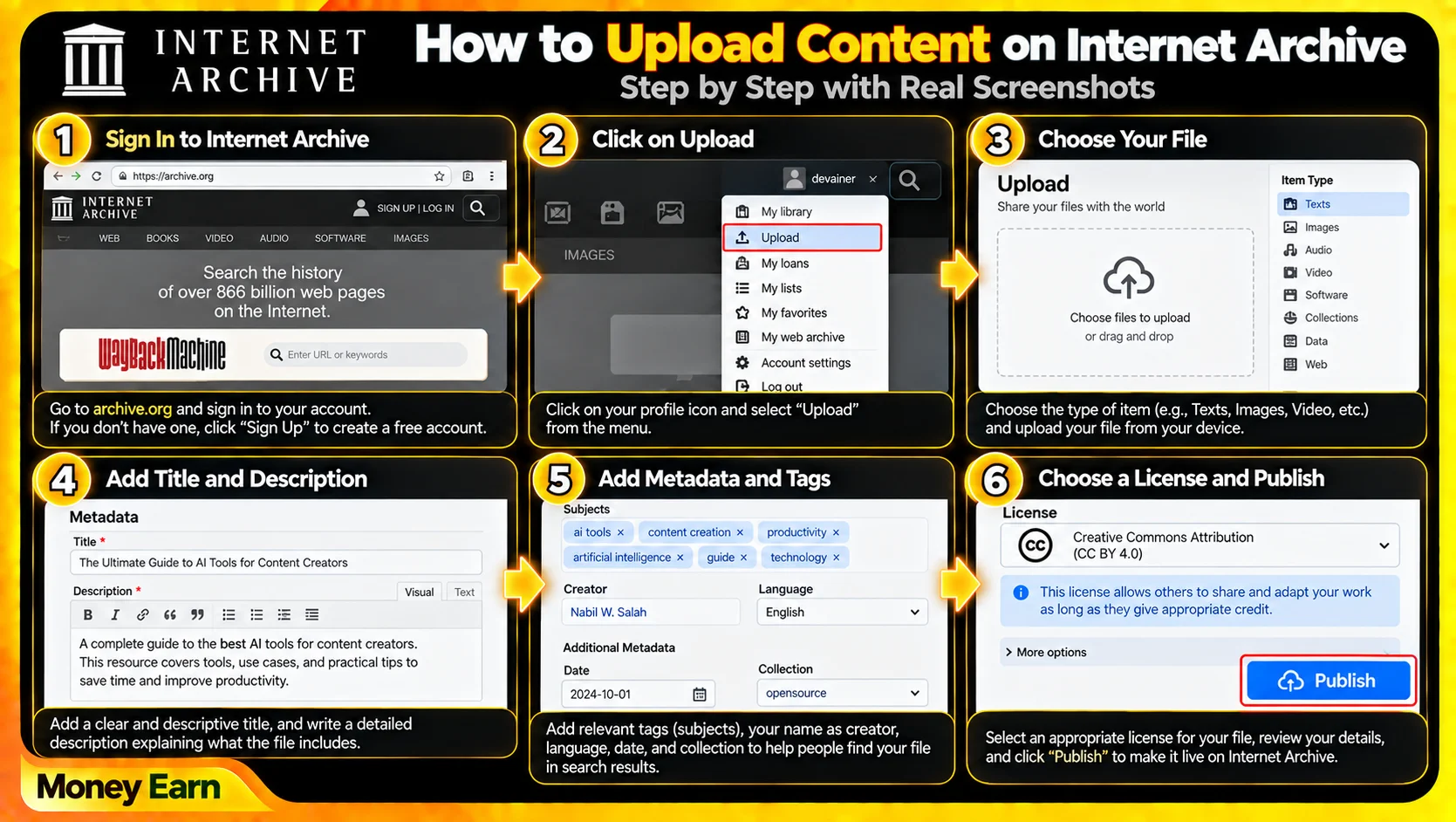
During the upload process, pay close attention to metadata. Your title should clearly explain what the resource is rather than relying entirely on clickbait, while the description should tell people what it contains, who it’s designed for, and what problem it solves.
Add accurate subjects or tags and complete other relevant information such as creator, publication date, language, and licensing details.
Most importantly, don’t choose a license randomly.
The license should reflect the rights you actually own and the permissions you genuinely intend to grant.
Optimize Your Internet Archive Upload for Search
Don’t approach optimization by asking how you can trick Google into ranking an upload.
Ask how you can make the page easier for both users and search engines to understand.
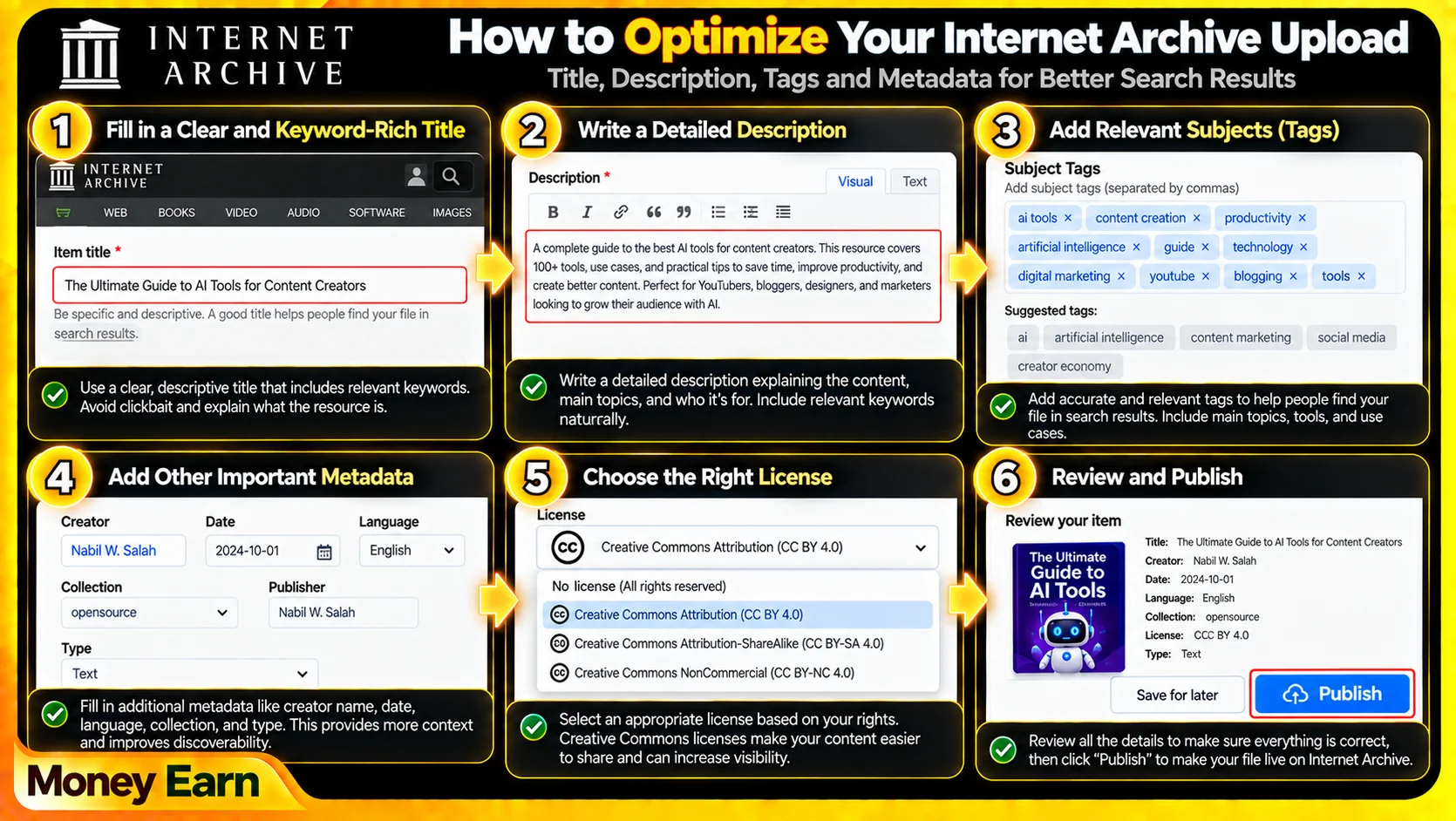
Suppose your document is called “AI Content Creation Checklist for Beginners.” Use a clear title around that topic, write a natural description explaining exactly what the resource contains, add relevant metadata, and make the document itself useful.
Avoid stuffing the same keyword dozens of times into the description.
And don’t assume every upload will automatically rank simply because it’s hosted on Archive.org. The platform can provide another discovery opportunity, but individual resources still need useful content, relevant metadata, and genuine demand.
Don’t Build One File — Build a Library
One useful document might send you some traffic.
That’s a good start.
But the strategy becomes more interesting when you gradually create a library of genuinely useful resources around the same niche.
If you’re targeting freelancers, for example, your collection might eventually include a proposal checklist, client onboarding template, pricing guide, project questionnaire, cold outreach guide, invoice checklist, and portfolio guide.
Each resource creates another potential discovery point for your brand.
You’re no longer hoping one PDF becomes popular.
You’re building a portfolio of traffic assets.
That doesn’t mean generating 50 nearly identical AI documents. Every resource should solve a distinct problem and deserve to exist on its own.
The Real Opportunity Isn’t Internet Archive
This is the most important part.
Internet Archive isn’t your business. Your ecosystem is.
The platform gives you another way to distribute useful content, but ideally that discovery supports assets that are more closely connected to your business: your website, email list, products, services, YouTube channel, or community.
This also reduces your dependence on one traffic source.
A resource might begin on Internet Archive, introduce somebody to your website, turn that visitor into an email subscriber, and eventually lead them toward a product or service.
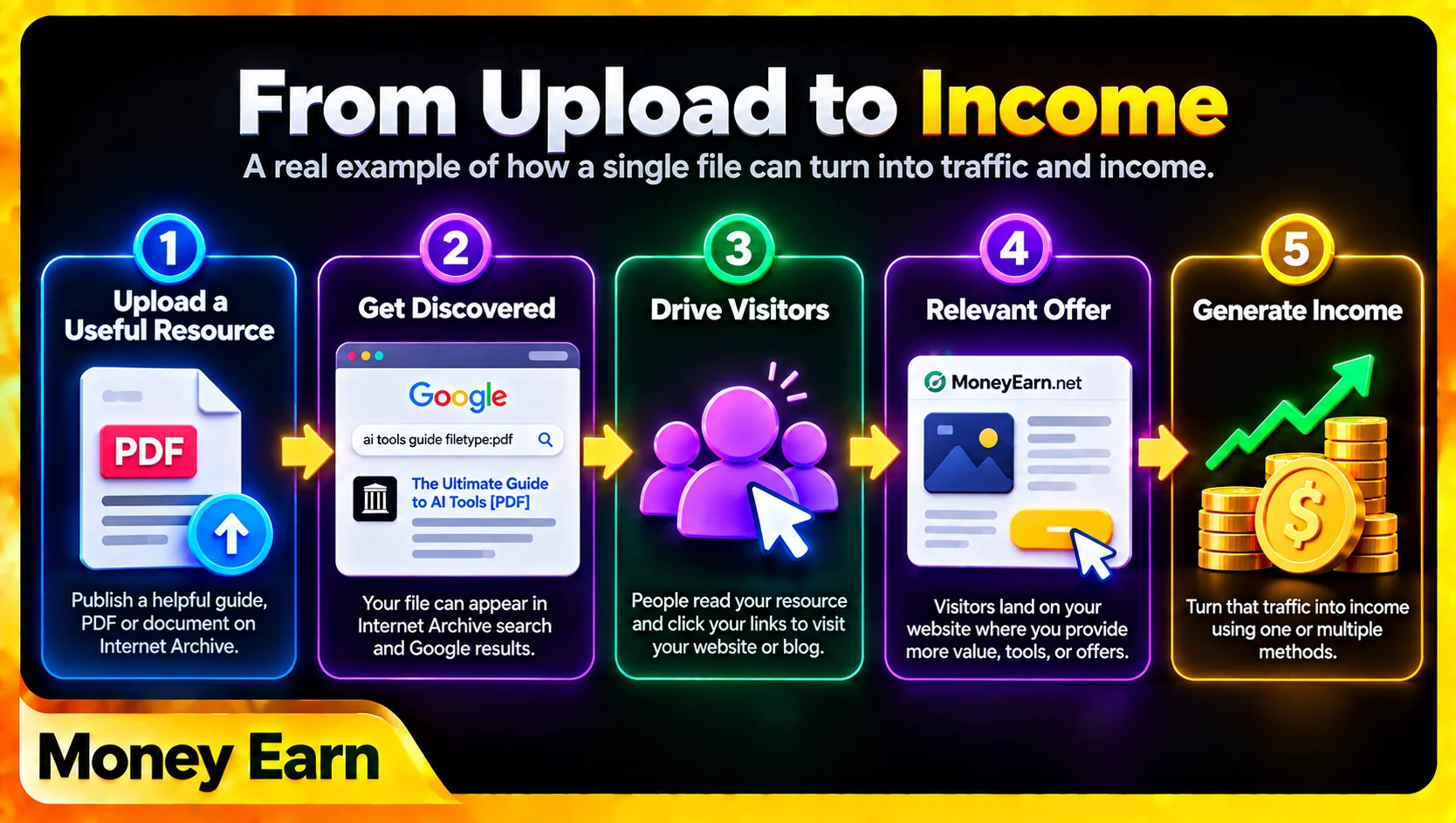
That’s when a distribution channel starts becoming part of a larger business system.
Final Thoughts: Turn Useful Files Into Traffic Assets
Internet Archive is enormous and gives creators another place where useful digital resources can potentially be discovered.
But don’t treat it as a shortcut.
Uploading a random PDF doesn’t automatically generate income. Uploading dozens of low-quality documents doesn’t create a business, and placing monetized links everywhere isn’t a strategy.
The stronger model is:
Find Demand → Create Value → Publish → Get Discovered → Redirect Attention → Monetize
That attention can support Direct Link Monetization, CPA Marketing, affiliate marketing, your website, or audience growth.
Start with one useful resource. Optimize it properly, publish it, and watch what happens. Then use what you learn to create the next one.
Over time, you’re not simply uploading files to Internet Archive.
You’re building digital assets that can keep introducing new people to your business.
Frequently Asked Questions
Can You Make Money With Internet Archive?
Yes, but Internet Archive doesn’t simply pay uploaders for every download. The opportunity is using legitimate resources as a discovery and traffic channel that can support websites, affiliate marketing, advertising, services, products, or other online assets.
Does Internet Archive Get Search Traffic?
Internet Archive has substantial visibility in search engines, which can create another discovery path for useful resources. That doesn’t mean every upload will automatically rank, so content quality, demand, and accurate metadata still matter.
Can I Put Affiliate Links in a PDF?
PDF documents can technically contain hyperlinks, but whether a particular affiliate link is permitted depends on the affiliate program, distribution platform, disclosure requirements, and applicable rules. Check the specific terms before publishing.
Can I Upload Other People’s Books to Internet Archive?
Don’t assume that finding a book online gives you redistribution rights. Use material you own or content whose license, public-domain status, or explicit permission allows your intended distribution.
Is Internet Archive Good for Backlinks?
It can create links and referral opportunities, but an Archive.org backlink doesn’t automatically guarantee strong Google rankings. Treat relevant discovery and referral traffic as the primary opportunity rather than trying to manufacture backlinks.