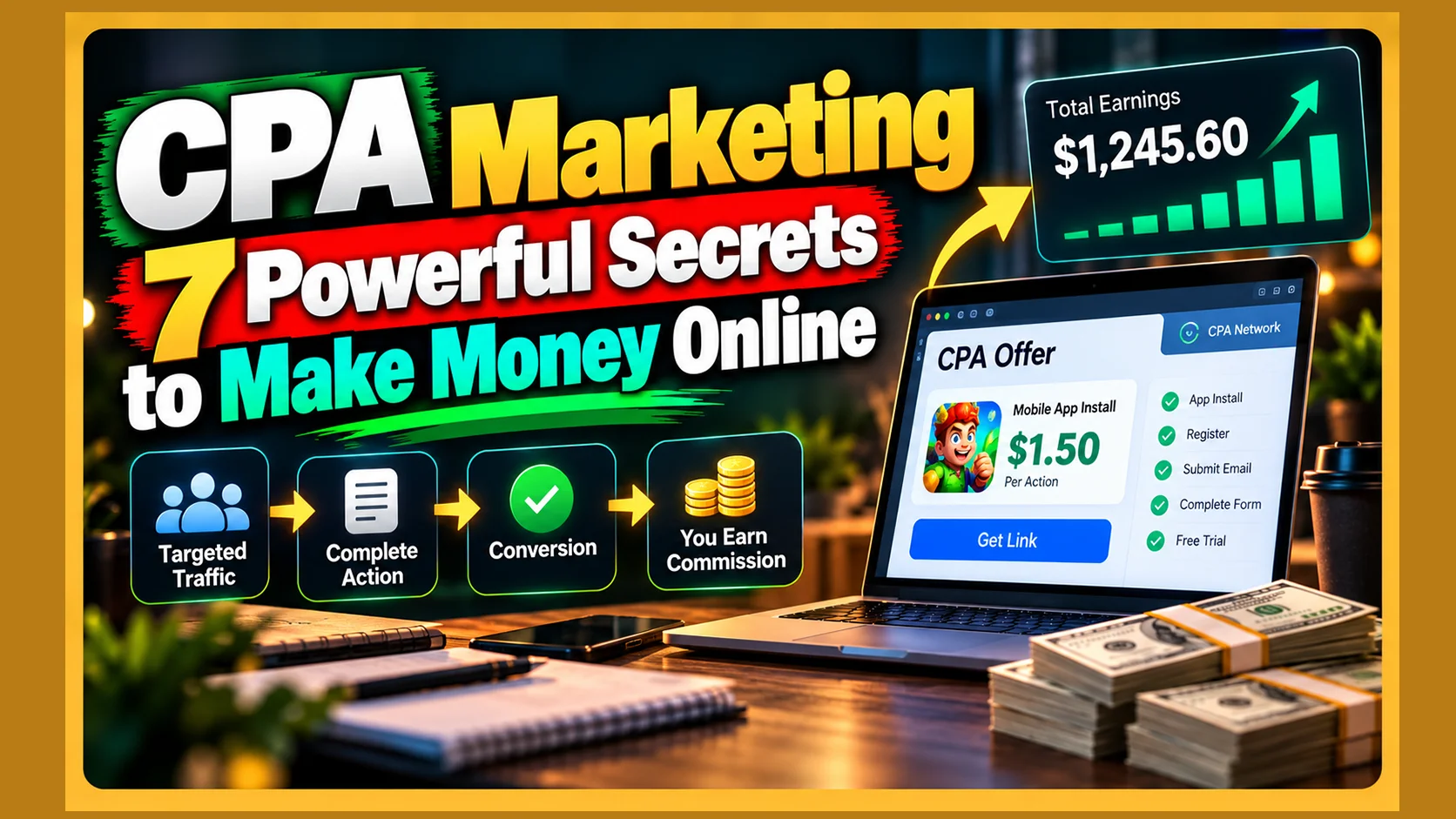
CPA Marketing: 7 Powerful Secrets to Make Money Online
CPA Marketing is one of those online income methods many beginners have heard about but never fully understood. Yet people have built entire online businesses around this model for years.
Unlike traditional affiliate marketing, you don’t always need someone to buy a product before you earn a commission. Depending on the offer, a visitor might only need to install an app, submit an email, register for a service, complete a form, start a trial, or perform another required action.
Complete the required action — and you can earn a commission.
No inventory. No shipping. No need to create your own product or show your face.
But there’s one thing you absolutely need:
Traffic.
The real skill behind CPA Marketing is matching the right offer with the right audience and turning targeted visitors into specific actions. In this guide, you’ll learn how that system works, how beginners can get traffic, and the biggest mistakes to avoid.
Table of Contents
- What Is CPA Marketing?
- How Does CPA Marketing Work?
- CPA Marketing vs. Direct Link Monetization
- Choose the Right CPA Offer
- Build a Landing Page
- Get Free Traffic
- Test and Track Your Campaigns
- CPA Marketing Mistakes
- The CPA Marketing Formula
- Frequently Asked Questions
What Is CPA Marketing?
CPA commonly means Cost Per Action or, depending on the network and context, Cost Per Acquisition.
The concept is simple. An advertiser wants users to perform a specific action. You send potential users to the advertiser, and when an eligible visitor completes the required action according to the offer’s rules, you earn a commission.
For example, imagine an offer pays $1 for every eligible U.S. visitor who installs an app and completes the required action. You send 100 qualified visitors and 10 complete it. Those 10 conversions are what generate your commission.
Other offers might pay for registrations, email submissions, trials, surveys, lead forms, game engagement, or other specified actions.
That’s what makes CPA Marketing interesting: the user doesn’t necessarily have to purchase something before you can earn.
How Does CPA Marketing Work?
The basic system looks like this:
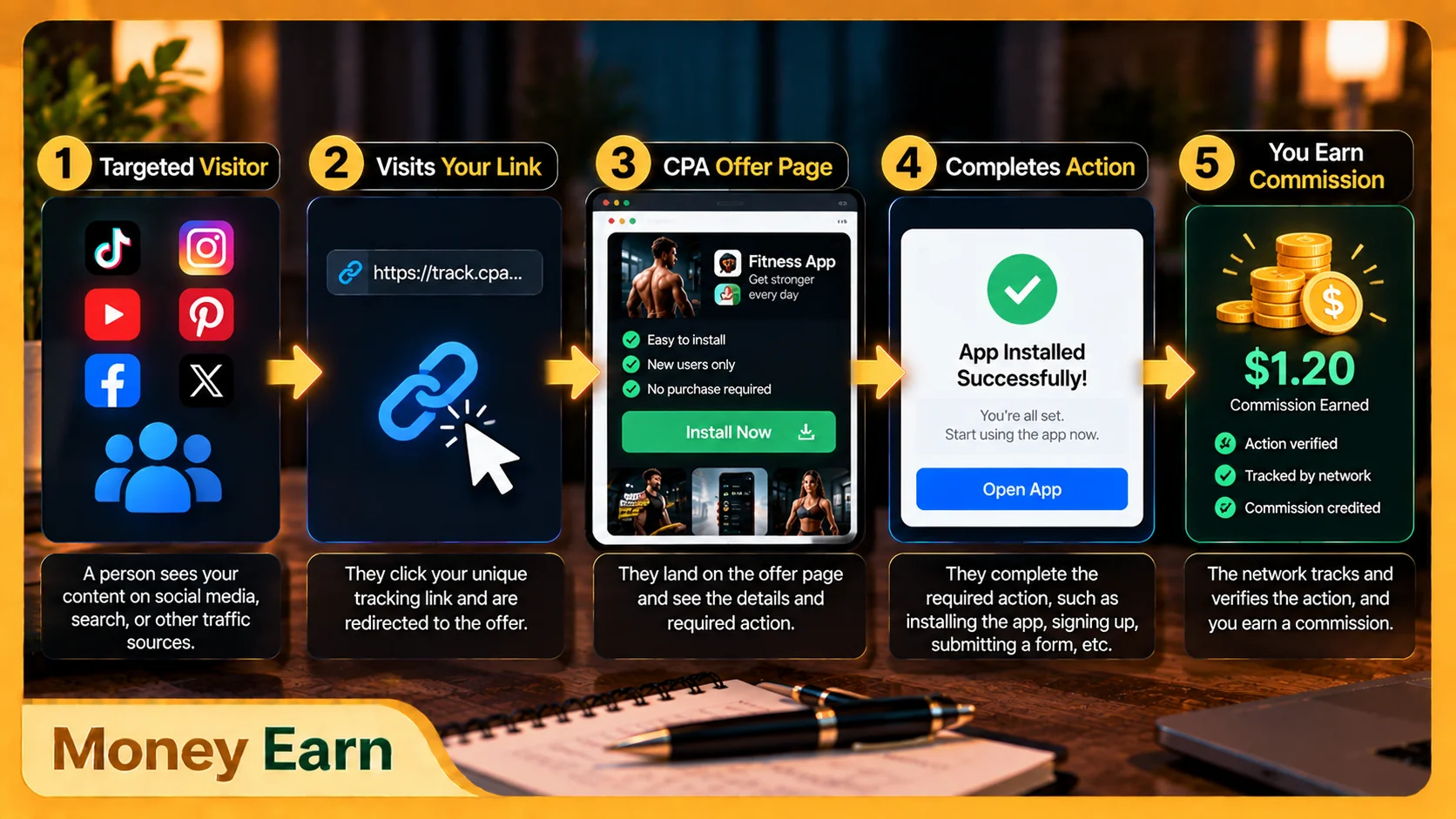
CPA Offer → Tracking Link → Targeted Traffic → Action → Commission
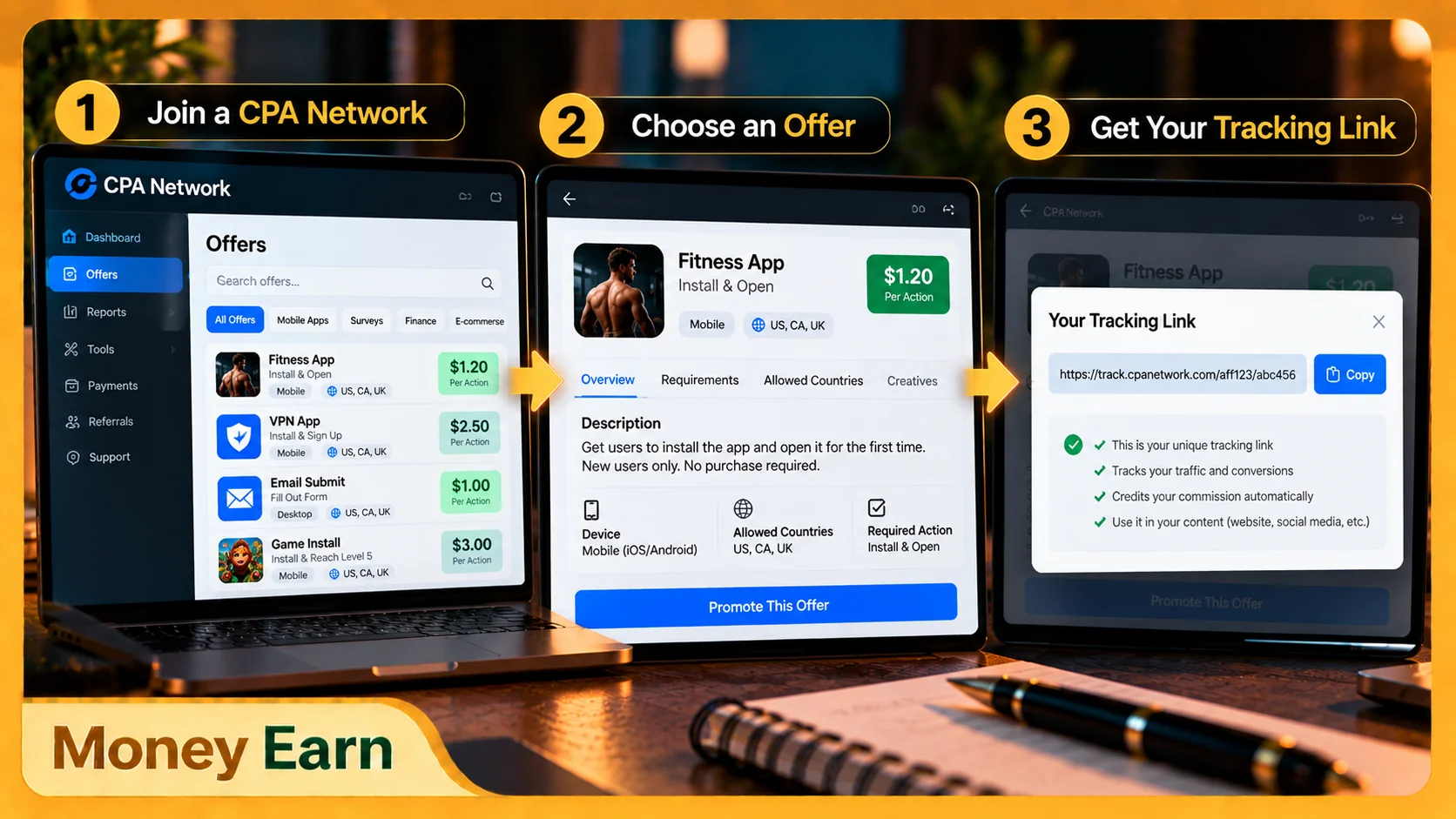
You join a CPA network, choose an offer, and receive a unique tracking link. You then promote that offer using an approved traffic source.
When someone clicks, completes the required action, and meets the offer’s requirements, the network tracks the conversion and credits the commission.
Simple concept. But don’t confuse simple with automatic.
The real game is:
Right Offer + Right Audience + Right Traffic
You could send thousands of visitors to the wrong offer and generate almost nothing. The same traffic matched with an offer those visitors genuinely care about could perform completely differently.
CPA Marketing vs. Direct Link Monetization
CPA Marketing and Direct Link Monetization can look similar because both depend heavily on traffic, but the monetization logic is different.
With Direct Link Monetization, users are generally routed through an advertising monetization system, where revenue can depend on factors such as geography, visitor quality, advertising demand, and the network’s model.
With CPA Marketing, the objective is clearer:
Get the required action.
If you send 1,000 visitors to an offer, saying “I generated 1,000 visits” doesn’t tell you whether the campaign worked. What matters is how many of those visitors completed the required action.
That’s why CPA teaches you to think beyond clicks and focus on conversions.
CPA isn’t the only way to monetize online traffic. If you want to explore other models, including Direct Link Monetization, AI services, digital products, and affiliate content, check out our guide to 4 powerful ways to make money online in 2027.
1. Choose the Right CPA Offer
Beginners often see one offer paying $1 and another paying $10 and immediately choose the $10 offer.
That’s a mistake.
The $1 offer might require one simple action, while the $10 offer could require multiple steps, payment information, a purchase, or another action with much more friction.
Imagine:
$1 offer × 100 conversions = $100
while:
$10 offer × 2 conversions = $20
The bigger payout didn’t produce the bigger result.
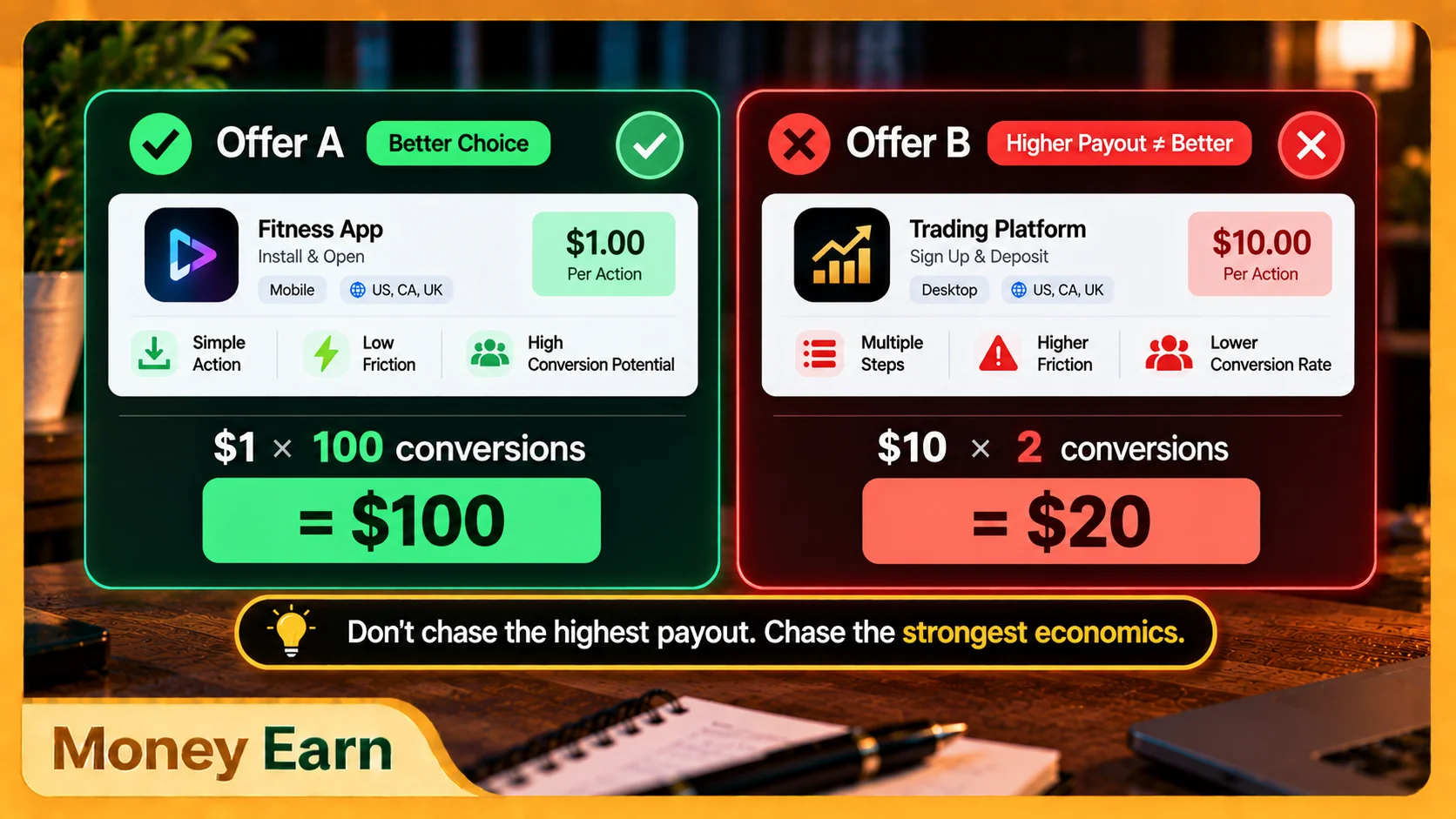
Don’t chase the highest payout. Chase the strongest economics.
When choosing an offer, check the allowed countries, supported devices, required action, payout, traffic restrictions, and whether your audience would genuinely want what you’re promoting.
For example, a mobile game makes sense for gaming audiences. A productivity app might fit students, freelancers, professionals, and content creators.
Instead of asking:
“Where can I dump this link?”
Ask:
“Who would genuinely want this?”
That question alone can dramatically improve your strategy.
2. Find a CPA Network
CPA networks connect advertisers with publishers and affiliates who can send them traffic. Networks associated with CPA and performance marketing have included platforms such as OGAds, CPAGrip, CPALead, MyLead, AdWork Media, AdGate Media, and MaxBounty.
Different networks can have different offers, countries, approval processes, payout structures, traffic requirements, and promotion rules.
You don’t need accounts with ten networks on your first day. Start with one or two, understand how they work, read their rules, and learn how to generate actual conversions.
Some networks may also ask how you plan to promote their offers. If they ask where your traffic will come from, explain your real strategy rather than inventing something you think sounds impressive.
Your strategy might include short-form content, landing pages, YouTube, TikTok, Facebook, Instagram, Pinterest, Telegram, or another permitted traffic source.
Most importantly:
Be truthful.
Fake traffic, bots, prohibited promotion methods, and manufactured conversions can destroy an account before you’ve built anything worthwhile.
3. Build a Landing Page That Converts
Another classic beginner mistake is receiving a CPA link and immediately throwing it everywhere.
A simple landing page can create a much better experience because it gives visitors context before they reach the offer.
Suppose you’re promoting a productivity app. Your page could briefly explain what the app does, who it’s useful for, its main benefits, and why someone might want to try it. Add a relevant visual and a clear call to action.
Now your funnel becomes:
Content → Landing Page → CPA Offer
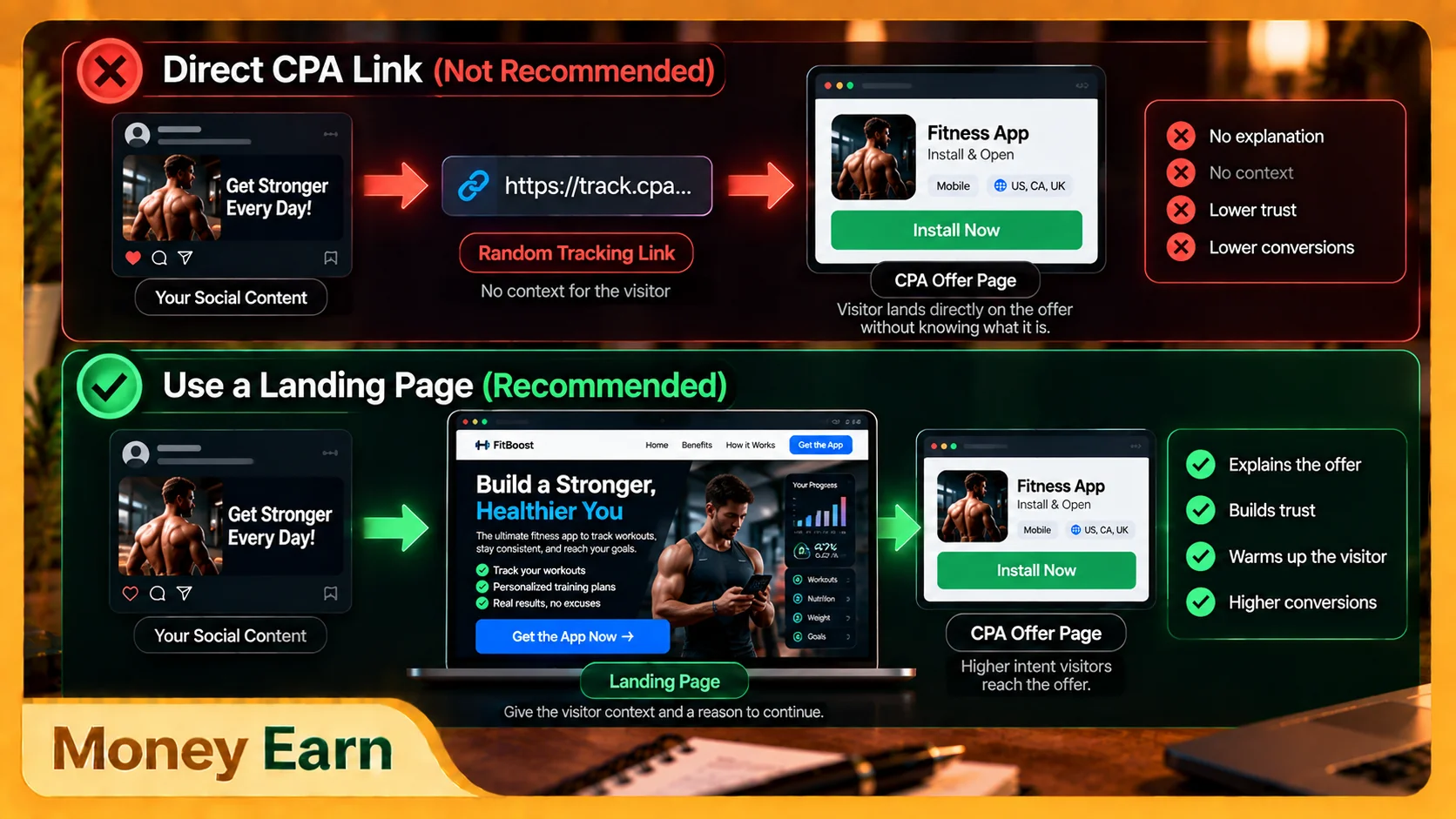
Instead of sending a stranger directly to an unfamiliar tracking URL, you’re giving them a reason to continue.
Your landing page doesn’t need to be complicated, but it should provide real value. Avoid empty pages containing nothing except giant DOWNLOAD NOW!!! buttons.
If you’re using content locking, the same principle applies. There should actually be something valuable behind the lock. Don’t promise resources that don’t exist, use fake buttons, or trick visitors into completing actions they don’t understand.
Short-term tricks can create long-term problems.
4. Get Free Traffic for CPA Marketing
Without traffic, CPA Marketing doesn’t move.
No visitors means no clicks. No clicks means no conversions. And no conversions means no commissions.
If you’re starting without a large budget, organic traffic gives you a chance to learn before risking significant money. Potential sources include TikTok, Facebook Reels, Instagram Reels, YouTube Shorts, Pinterest, Reddit, Quora, and Telegram.
But don’t try to use all of them.
Choose one niche and one or two platforms where your audience already spends time. Then create content consistently and study what gets attention.
Suppose you’re promoting mobile apps. Instead of posting “CLICK MY LINK!”, create useful content with hooks such as:
“3 free apps that can make your phone more useful.”
Or:
“I wish I knew about this app earlier.”
The content gets attention first. Then interested viewers have a natural reason to continue toward your landing page or offer.
Your opening matters too. Short-form users decide quickly whether to keep watching, so skip slow introductions and lead with the interesting part.
Hook → Value → Next Step
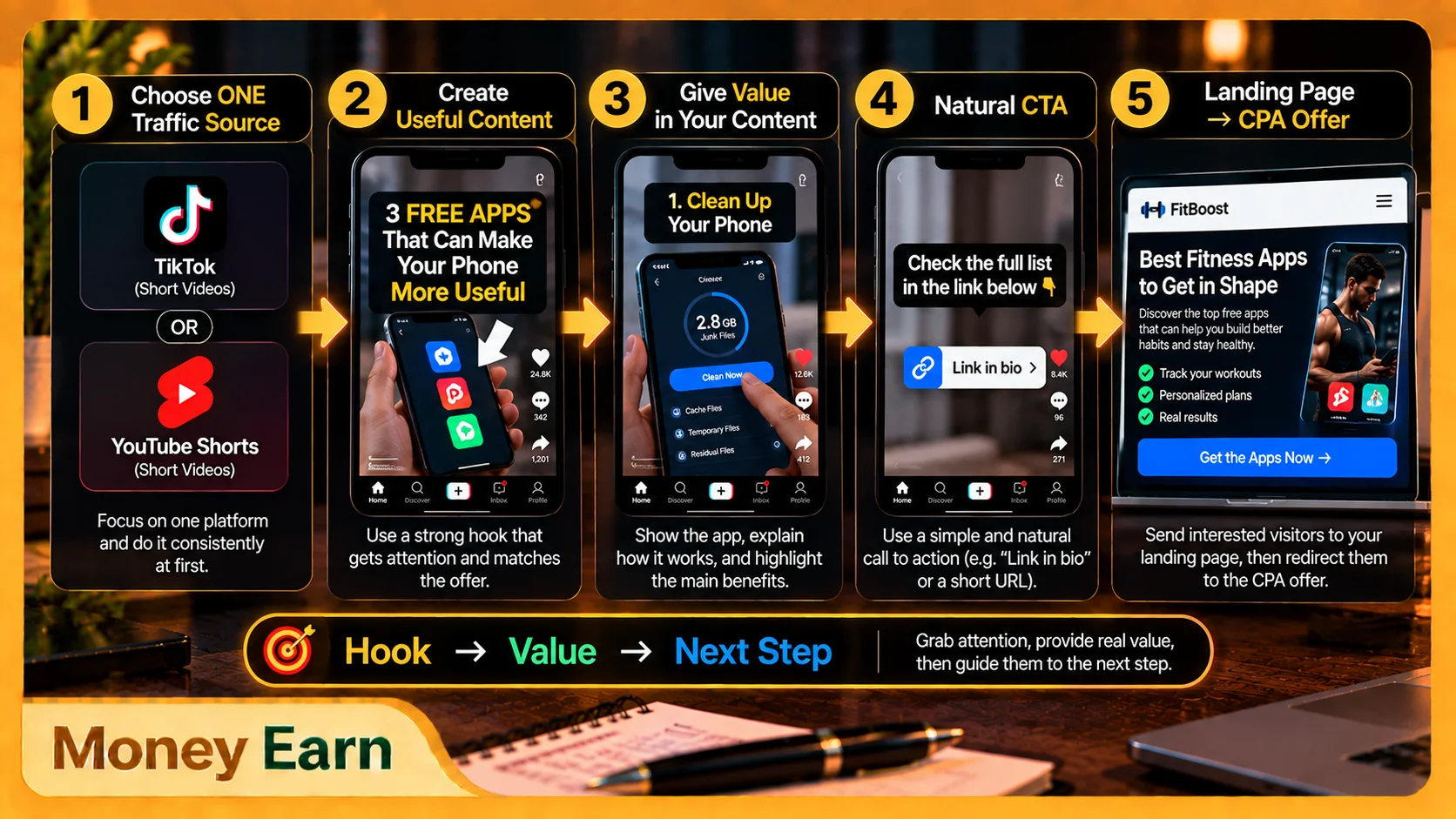
That’s a much stronger traffic strategy than spamming links.
5. Stop Changing Your Niche Every Two Days
Monday you’re promoting gaming. Tuesday it’s AI. Wednesday it’s movies. By Friday you’ve moved to jobs or VPN offers.
Then you conclude CPA Marketing doesn’t work.
It isn’t CPA that you tested.
You tested chaos.
Choose one niche and create enough content to collect meaningful data. Test different hooks and formats while keeping the audience and core offer relatively consistent.
Watch which content gets views, which generates clicks, and which traffic actually converts.
If you constantly change the niche, offer, audience, platform, and content style at the same time, you’ll never know what caused the result.
Consistency gives you useful data.
6. Test Paid Traffic Carefully
Once you understand your offer and funnel, paid traffic can become another option where the CPA network and specific offer permit it.
But don’t throw hundreds of dollars into your first campaign.
Start with a small test budget you’re prepared to lose and measure what happens. Suppose you spend $10 and generate $3. You may have received conversions, but the campaign is still losing money.
If you spend $10 and generate $18, you’ve created an $8 difference before any additional expenses.
The basic calculation is:
Revenue − Traffic Cost = Gross Campaign Difference
The goal isn’t simply getting conversions. It’s building a campaign where the economics make sense.
That’s why CPA connects naturally with Traffic Arbitrage: you’re constantly comparing what traffic costs with the value that traffic generates.
7. Track the Numbers That Matter
CPA Marketing becomes much easier to understand when you stop guessing.
Imagine 1,000 people see your content. One hundred visit your landing page, 40 continue to the offer, and five complete the required action.
Now you have a measurable funnel:
Views → Landing Page Visits → Clicks → Conversions → Revenue
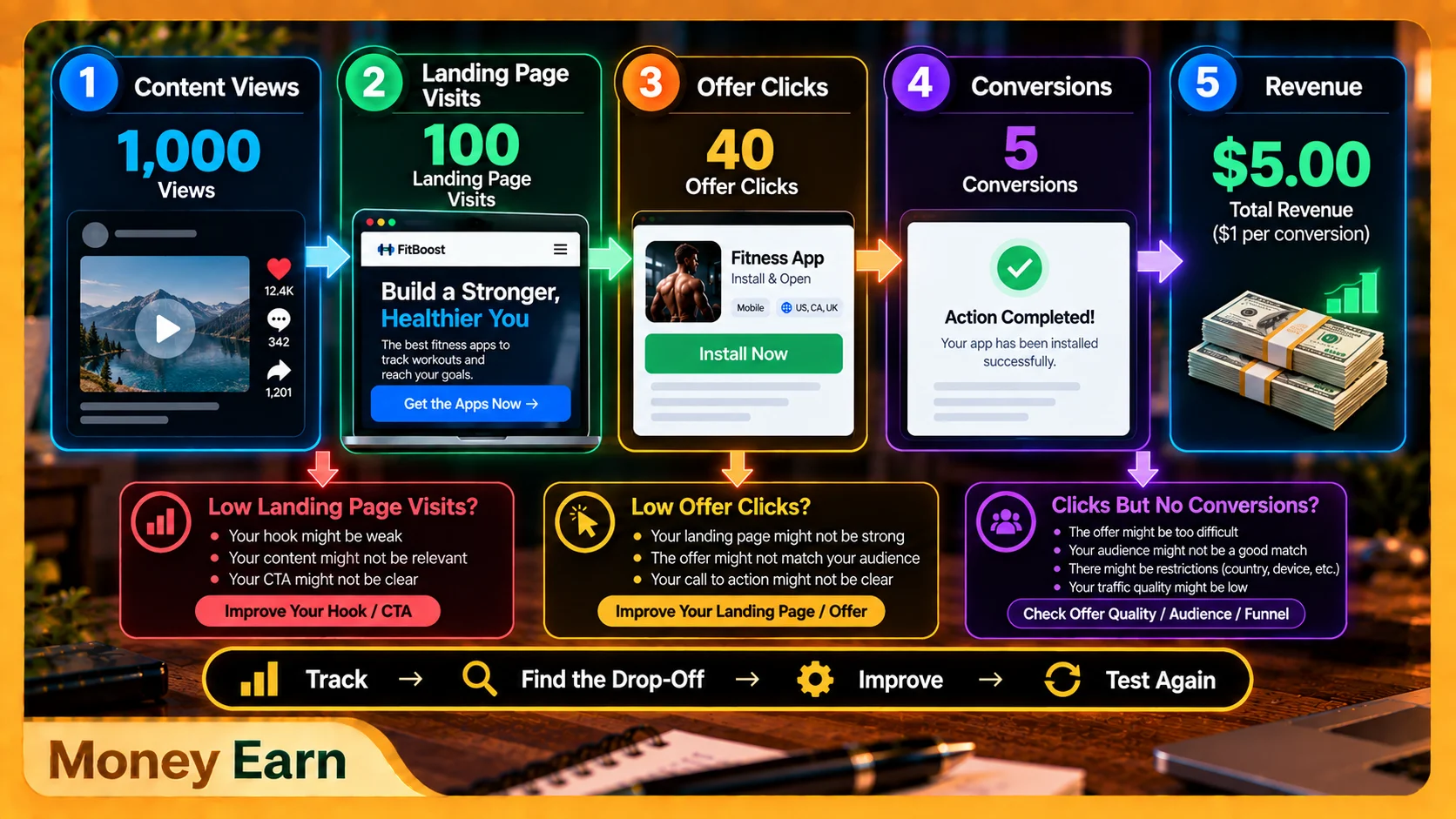
If your content gets views but nobody visits the page, your call to action might be weak. If people visit but don’t continue, your landing page or offer may not be attractive enough.
If visitors click through but don’t convert, the offer, audience, expectations, or funnel could be mismatched.
That’s why tracking matters. Instead of saying “CPA isn’t working,” you can identify where the system isn’t working.
Then you can improve that specific part.
CPA Marketing Mistakes to Avoid
Some mistakes can hurt more than your conversion rate. They can create serious problems with the CPA network itself.
Avoid fake traffic and don’t buy bots pretending they’re real visitors. Don’t attempt to create your own conversions through fake identities, VPN manipulation, or similar methods.
Spam is another major mistake. Throwing tracking links into unrelated groups isn’t a real marketing strategy. Neither is misleading visitors with fake promises just to generate an action.
Always read the offer restrictions. Countries, devices, traffic types, promotional methods, keywords, and advertising claims may all have specific rules.
And don’t scale a campaign because you got one conversion.
Test first. Collect data. Then scale what works.
CPA Marketing Isn’t a Magic Link
Beginners often search for the “best CPA link to make money,” as if the right tracking URL will suddenly solve everything.
It won’t.
A profitable CPA system is much closer to:
Right Offer + Right Audience + Real Traffic + Strong Funnel = Conversions
Two marketers can promote exactly the same offer and produce completely different results. Their audience, content, landing page, targeting, traffic quality, and optimization may all be different.
The link isn’t the secret.
The system around the link is.
That’s the actual skill you’re learning.
A Simple CPA Marketing Plan
If you’re starting from zero, keep the process simple.
During your first stage, choose one niche, join a suitable CPA network, read the rules, and select an offer that matches your intended audience.
Next, create a simple landing page and several pieces of content around the problem that offer solves. Generate organic traffic and test different hooks without changing your entire strategy after a few days.
Then study the results. Which content generated traffic? Which visitors clicked? Which clicks became conversions? Where did people leave the funnel?
Use those answers to improve your next test.
That’s how you learn CPA Marketing:
Test → Measure → Improve → Repeat
Not by hunting for a secret link.
The CPA Marketing Formula
The entire model can be summarized as:
Offer → Audience → Content → Landing Page → Action → Commission
But there’s an even more important version:
The Right Offer + The Right Person + The Right Message = A Chance to Convert
You don’t need millions of followers, your own physical product, or celebrity status. You need to understand what the visitor wants and why they would be interested in the action you’re promoting.
Because CPA Marketing isn’t really about links.
It’s about matching people with actions they’re genuinely interested in taking.
Final Thoughts
CPA Marketing has existed for years, yet many beginners still overlook it while jumping between dropshipping, YouTube, traditional affiliate marketing, and whatever new online side hustle is trending.
The core idea is much simpler.
An advertiser wants an action. You find the right audience and send legitimate targeted traffic. When an eligible user completes the required action according to the offer’s terms, you earn a commission.
Simple idea.
But mastering it takes testing.
Don’t chase every high-paying offer. Don’t spam links. Don’t fake traffic. And don’t switch between five niches before you’ve properly tested one.
Start with:
One Niche → One Offer → One Audience → One Funnel
Generate real traffic, track what happens, improve weak parts of the funnel, and expand what performs well.
Once you understand CPA Marketing, you’re learning something much more valuable than how to promote one offer:
How to turn targeted traffic into measurable actions — and measurable actions into revenue.
Frequently Asked Questions
What Is CPA Marketing?
CPA Marketing is a performance marketing model where an affiliate or publisher can earn a commission when an eligible visitor completes a specific action defined by an advertiser.
What Does CPA Mean?
CPA commonly stands for Cost Per Action or Cost Per Acquisition, depending on the network and context.
Can Beginners Make Money With CPA Marketing?
Yes, beginners can learn CPA Marketing. Results depend on offer selection, audience targeting, traffic quality, conversion rates, and how well the overall funnel performs.
Do I Need a Website for CPA Marketing?
Not every campaign requires a full website, but a landing page can provide context and create a stronger bridge between your traffic source and the offer.
Is CPA Marketing the Same as Affiliate Marketing?
They’re related. Traditional affiliate marketing is often associated with commissions from sales, while CPA offers can pay for other eligible actions such as registrations, leads, trials, or app-related actions.
What’s More Important: CPA Payout or Conversion Rate?
Both matter. A high-paying offer can still generate less revenue if very few visitors complete it. Evaluate the complete economics of the campaign instead of choosing an offer based only on payout.